
India’s Strategy of Energy Autonomy
Following the 2022 sanctions on Russia, India prioritized national energy security by significantly increasing its intake of discounted Russian crude, reshaping its energy economics and serving as a global supply "safety valve."
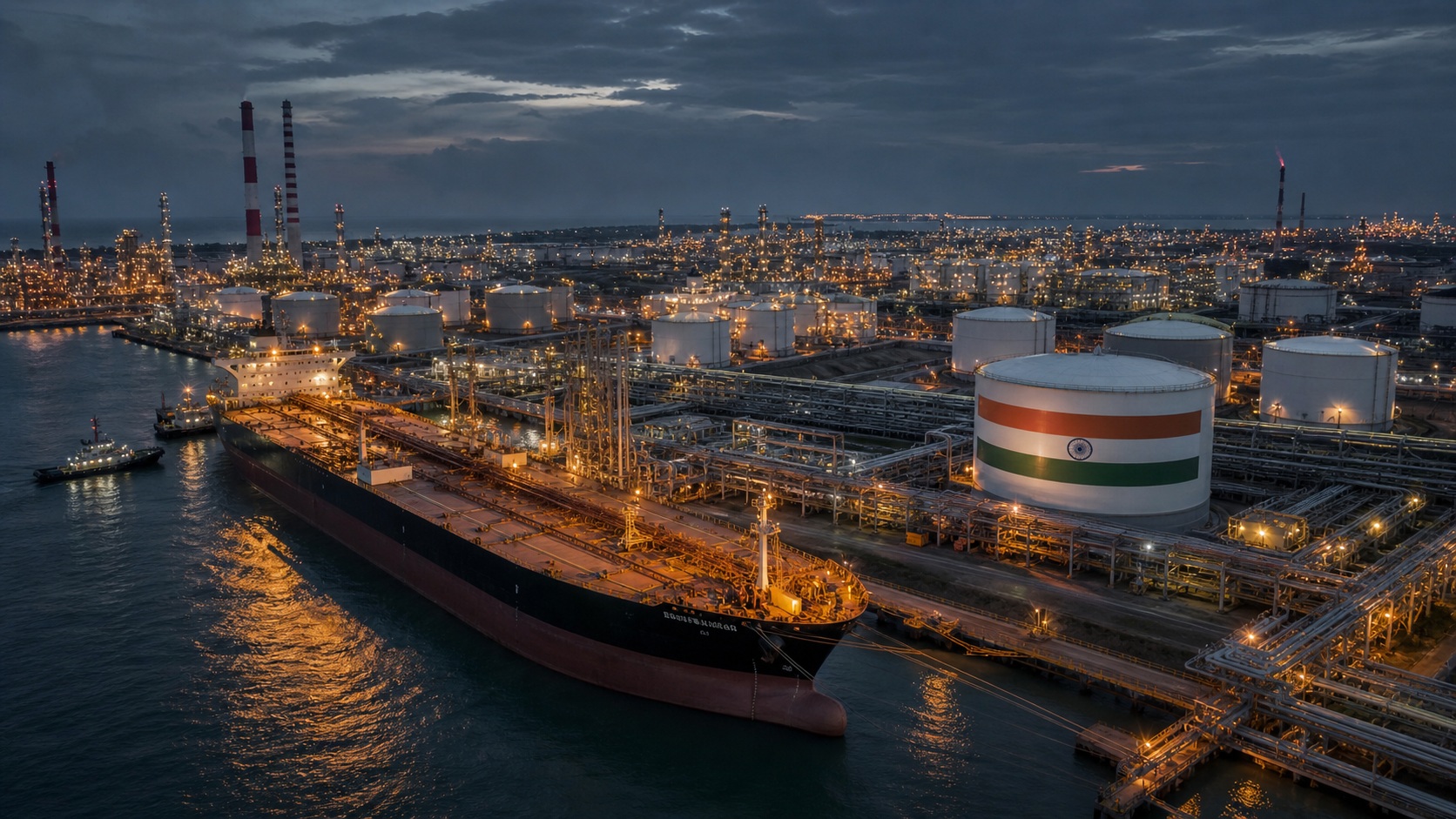
India’s Strategy of Energy Autonomy
In the weeks after Russia’s invasion of Ukraine in February 2022, Western countries moved quickly to impose sweeping sanctions and pushed allies to cut off Russian energy purchases. India chose a different path. Instead of reducing imports, it significantly increased its intake of discounted Russian crude, emerging as Moscow’s key buyer at a time when the West was stepping away.
The decision reflected a clear strategic stance—prioritizing national energy security and economic advantage over geopolitical alignment—and it reshaped India’s energy economics in the years that followed.
How the Shift Happened
Before 2022, Russia played only a minor role in India’s oil supply, accounting for less than 2% of total imports. Within a year, that changed dramatically:
- By mid-2023: Russia’s share of Indian crude imports surged to a peak of nearly 40%.
- By 2024–2025: Russia’s share stabilized at approximately 35%, maintaining its position as India’s largest supplier ahead of Iraq and Saudi Arabia.
This shift was driven by deep, albeit fluctuating, discounts. While peak discounts hit $30 per barrel in early 2022, they narrowed to $4–$10 by 2024. Despite this narrowing, the scale of imports meant India saved an estimated $12–$15 billion on its import bill between 2022 and 2024.
Western Pressure — and India’s Response
The move did not go unnoticed. Governments in the U.S. and Europe repeatedly urged India to adhere to the G7 price cap of $60 per barrel. India’s response remained consistent, framing energy procurement as a sovereign decision. Officials argued that a developing economy cannot compromise energy access for its 1.4 billion citizens for the sake of external political alignment.
This position proved effective. Because the West feared a global price spike if Russian oil was completely removed from the market, India was largely allowed to continue its purchases, serving as a "safety valve" for global supply.
The Economic Logic
At its core, the decision was driven by straightforward financial reasoning. With an annual oil import bill often exceeding $130 billion, discounted crude offered vital relief against inflation.
The benefits were also operational. Indian refineries—particularly the Jamnagar complex operated by Reliance Industries—were already equipped to process heavy Russian Urals. This allowed India to not only meet domestic demand but to export refined products back to Europe. In a strange twist of geopolitics, European countries were often running their transport sectors on Russian molecules "sanitized" by Indian refineries.
A Strategic Signal
Beyond economics, this era reinforced India’s commitment to strategic autonomy. It demonstrated that the country could maintain a "Comprehensive Global Strategic Partnership" with the U.S. while simultaneously acting as a primary economic partner for Russia.
A Stress Test for Sanctions
The episode highlighted a major limitation in the global sanctions framework. Sanctions are only as strong as the world's willingness to follow them. India’s continued purchases demonstrated that when a large, energy-dependent economy remains outside the system, alternative trade flows will emerge. This has created a blueprint for other nations in the Global South to prioritize domestic stability over Great Power competition.