
Part 1) Red Sea Crisis: When Houthis Shut a Trade Route
The Red Sea crisis represents a significant disruption to international maritime trade, highlighting the vulnerability of critical global chokepoints.
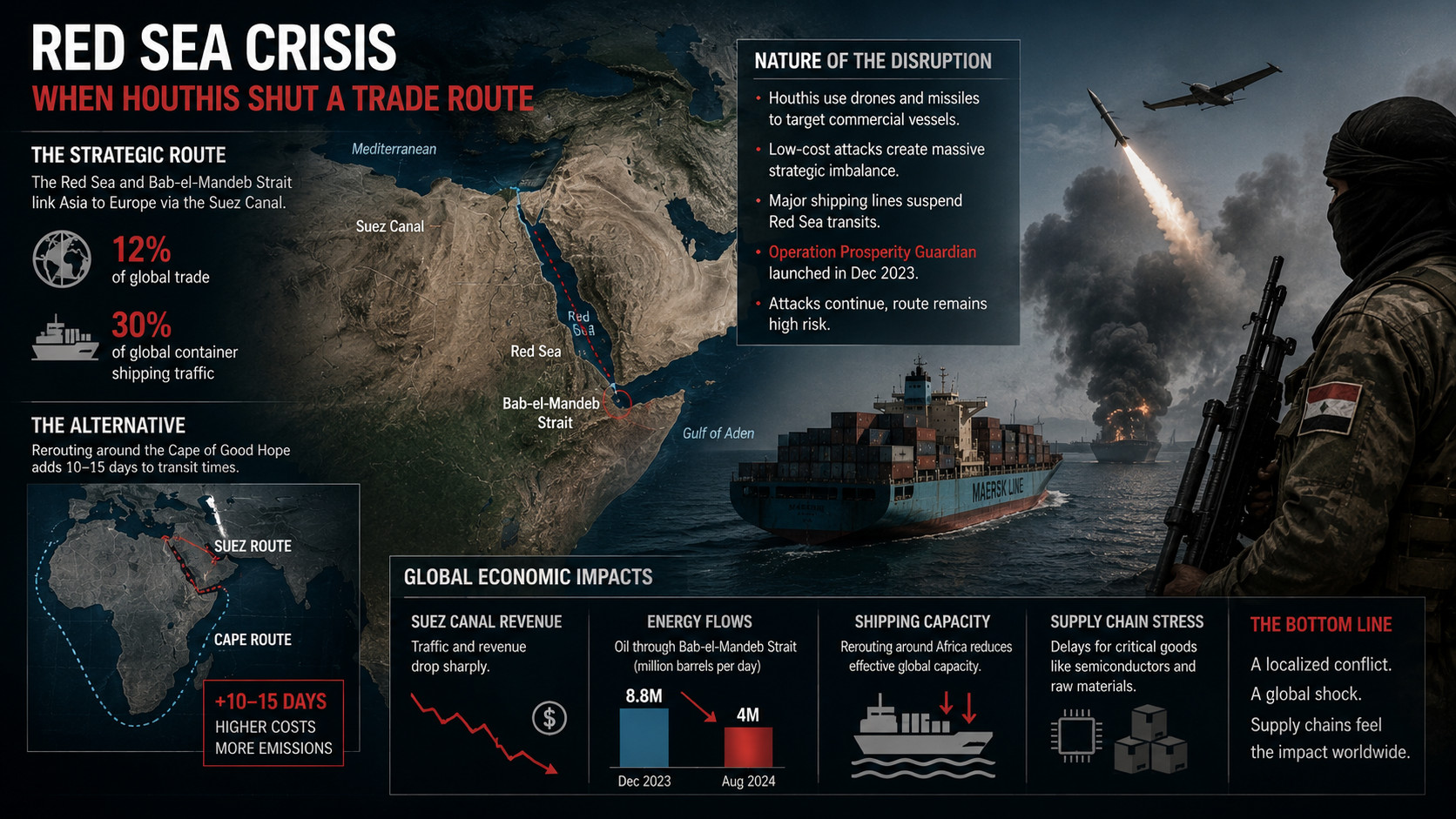
Red Sea Crisis: When Houthis Shut a Trade Route
The Red Sea crisis represents a significant disruption to international maritime trade, highlighting the vulnerability of critical global chokepoints. Starting in November 2023, the Houthi movement initiated a campaign of targeting commercial vessels transiting the southern Red Sea and the Bab-el-Mandeb Strait, initially citing connections to the conflict in Gaza but quickly escalating to threaten vessels regardless of nationality or destination.
The Strategic Importance of the Route
The Red Sea and the Bab-el-Mandeb Strait form a vital maritime corridor linking the Mediterranean Sea via the Suez Canal to the Indian Ocean. This route is essential for trade between Asia and Europe.
- Trade Volume: Prior to the disruptions, approximately 12% of global trade and nearly 30% of global container shipping traffic relied on this corridor (Sarkar et al., 2025).
- The Alternative: Rerouting vessels around the Cape of Good Hope adds roughly 10–15 days to transit times, significantly increasing fuel consumption, operational expenses, and carbon emissions (Sarkar et al., 2025).
Nature of the Disruption
The Houthis employed asymmetric warfare, utilizing low-cost drones and anti-ship missiles to threaten high-value commercial assets (Sarkar et al., 2025). This created a profound strategic imbalance: a relatively inexpensive attack could force a vessel carrying cargo worth hundreds of millions of dollars to alter its route, causing severe cascading effects on global supply chains (Sarkar et al., 2025).
By late 2023, major shipping lines—including Maersk, MSC, and CMA CGM—suspended transit through the region. In response, a coalition led by the United States launched Operation Prosperity Guardian in December 2023 to patrol the area and protect shipping lanes (RSIS, 2024). Despite these efforts, the Houthis maintained the capacity to conduct attacks, leading shipping companies to remain cautious and continue avoiding the route well into 2024.
Global Economic Impacts
The disruption had immediate and measurable consequences on global trade:
- Suez Canal Revenue: Traffic through the Suez Canal dropped sharply. By 2024, annual revenues for the canal had fallen significantly, impacting Egypt’s foreign currency reserves (DergiPark, 2025).
- Energy Flows: The volume of oil passing through the Bab-el-Mandeb Strait decreased markedly, from approximately 8.8 million barrels per day in December 2023 to roughly 4 million barrels per day by August 2024 (Frontiers, 2025).
- Shipping Capacity: Rerouting around Africa reduced the effective global shipping capacity by increasing the time required for each voyage, thereby limiting the number of trips a vessel can complete annually (Sarkar et al., 2025).
- Supply Chain Stress: The crisis has caused shipment delays for critical components, such as semiconductors and raw materials, forcing industries to contend with higher costs and extended production timelines (Sarkar et al., 2025).
Note: The Red Sea crisis serves as a modern example of how localized geopolitical events can rapidly transmit financial and logistical shocks through a tightly interconnected global economy.