
The Complex Reality of Economic Sanctions: Mechanisms, Impacts, and Outcomes
While often presented as decisive levers of pressure, historical evidence shows economic sanctions can succeed, fail, or produce unintended consequences depending on their design, global consensus, and the targeted nation's access to alternative trade routes.
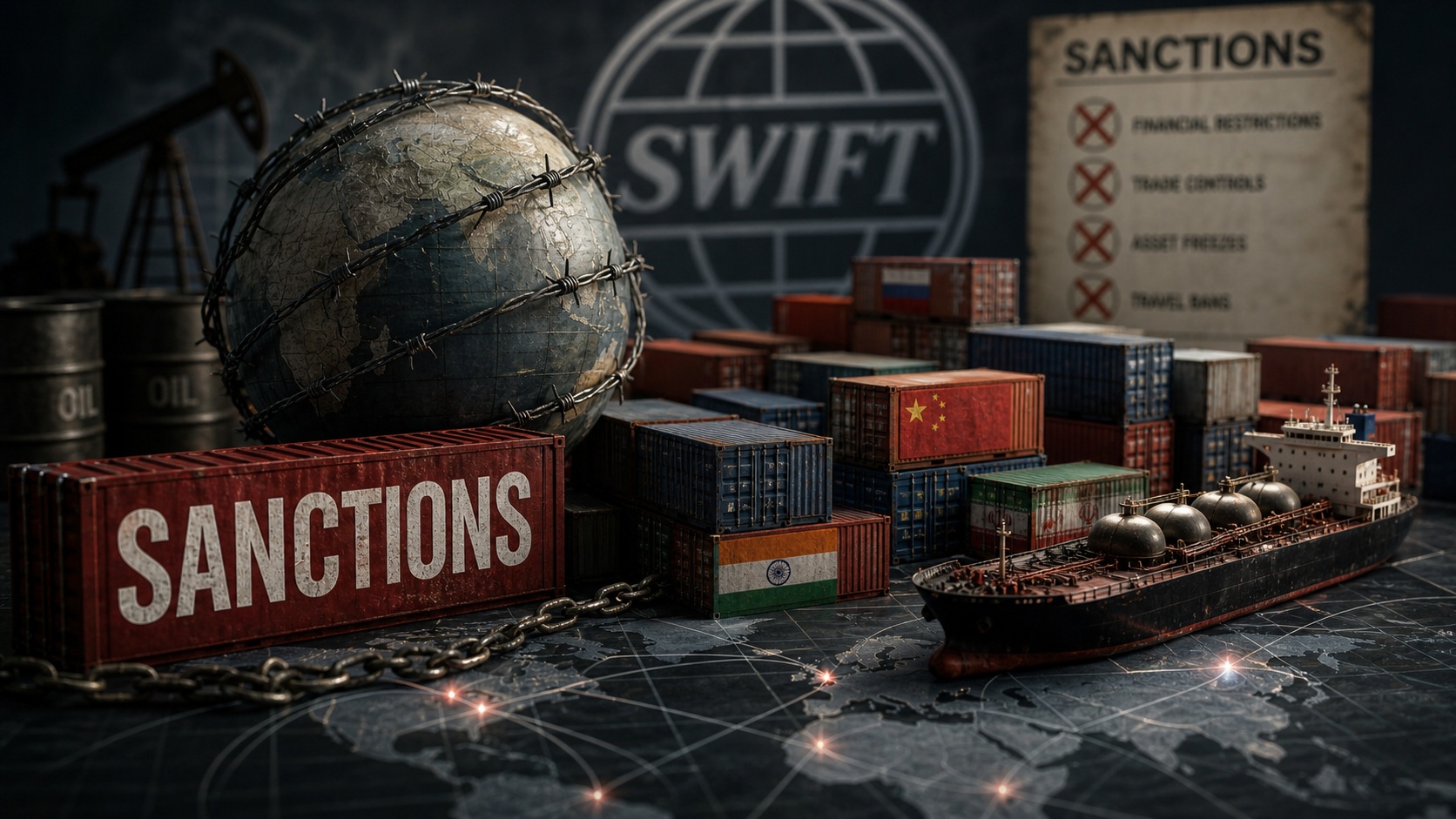
Sanctions are one of the most widely used tools in modern geopolitics—and also one of the least clearly understood. While imposing governments present them as decisive levers of pressure, those on the receiving end frame them as economic aggression. In practice, the outcomes are far more complex. Historical evidence shows that sanctions can succeed, fail, or produce unintended consequences depending on their design and the global economic context.
What Sanctions Really Mean
At their core, sanctions are economic measures intended to influence behavior. They can be applied by a single country (unilateral) or a coalition (multilateral), targeting a nation, organization, or individual. The tools vary in scope:
- Financial Restrictions: Limiting access to banking systems and global capital markets.
- Trade Controls: Blocking the flow of specific goods, such as "dual-use" technologies (civilian tech that can be used for military purposes).
- Asset Freezes: Preventing access to overseas central bank reserves and private property.
- Travel Bans: Restricting the movement of key political and business figures.
In extreme cases, these measures combine into near-total isolation, as seen in the long-standing regimes on Cuba, Iran, and North Korea. Effectiveness depends on multilateral participation and whether the target has access to alternative trade routes or "neutral" partners.
The Power of the SWIFT System
One of the most potent tools is exclusion from SWIFT (the Society for Worldwide Interbank Financial Telecommunication). This system connects more than 11,000 financial institutions across 200 countries, acting as the secure messaging backbone for international payments.
- The Iran Case (2012): When Iranian banks were disconnected from SWIFT, the impact was severe. Oil exports dropped from 2.2 million barrels per day in 2011 to roughly 700,000 barrels per day by 2013. The country lost approximately $4 billion to $8 billion in revenue per month.
- The Russia Case (2022): Several Russian banks were excluded following the invasion of Ukraine. However, the move was initially strategic; banks handling energy payments (like Gazprombank) were spared to prevent a total energy collapse in Europe, demonstrating how interdependence creates a "sanctions ceiling."
Why Sanctions Often Fall Short
Historical analysis suggests that sanctions are far from a "silver bullet." A seminal study by the Peterson Institute for International Economics (PIIE) examined over 200 cases and found that sanctions achieved their primary goals in only about 33% to 35% of episodes. For large, resource-rich countries or those seeking "regime change," the success rate drops significantly.
Common reasons for failure include:
- Alternative Trade Flows: Sanctioned states shift trade to non-participating nations (e.g., Russian oil flowing to India and China).
- The "Rally 'Round the Flag" Effect: External pressure can allow leaders to blame domestic economic hardship on foreign "aggression," actually strengthening their political grip.
- Humanitarian Impact: Broad sanctions often hit the general population and vulnerable groups hardest, while the targeted elite remains insulated through black markets.
What Makes Sanctions Effective
When sanctions succeed—as they partially did with the 2015 JCPOA (Iran Nuclear Deal)—they typically share four features:
- Narrow Focus: They target specific behaviors or sectors rather than broad civilian needs.
- Global Consensus: Multilateral participation limits "leakage" to alternative markets.
- Clear Off-Ramps: They provide a transparent path for removal in exchange for compliance.
- Decisive Speed: Impact is highest before the target nation has time to reorient its economy.
The Bigger Picture
Sanctions rarely produce immediate, simple results. Instead, they often reshape trade flows into a "multipolar" economy, creating new financial alignments (such as the rise of non-dollar payment systems). In a world of interconnected economies, the goal of sanctions is shifting from "forcing compliance" to "increasing the cost of defiance."