
The Water Behind Artificial Intelligence: Why Data Centers Are Becoming a Resource Story
AI is typically discussed through software and semiconductors, but every major system depends on cooling. As companies race to build larger data centers, water availability is rapidly becoming a strategic, geographical, and economic constraint.
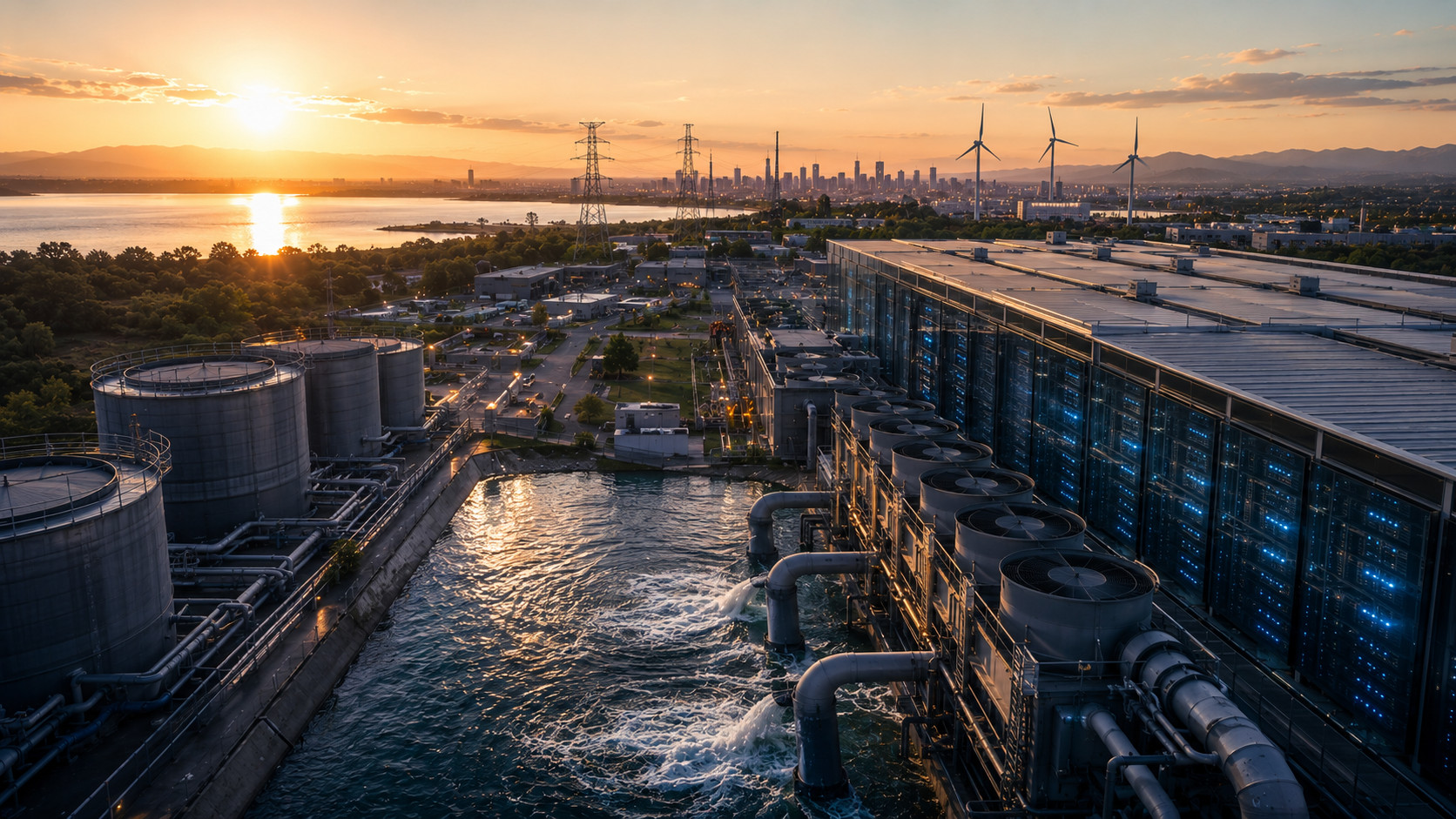
The Water Behind Artificial Intelligence: Why Data Centers Are Becoming a Resource Story
Artificial intelligence is usually discussed through the language of software, semiconductors, and computing power. But every major AI system also depends on something far more physical: cooling.
The servers inside data centers generate intense heat as they process information. Keeping that equipment within safe operating temperatures requires large cooling systems, and many of those systems use water directly or indirectly. As companies race to build larger AI facilities, the question is no longer only whether enough chips and electricity are available.
It is also whether enough water is available in the right place.
The Hidden Resource Behind Digital Growth
Data centers are often described as the factories of the digital economy. They store information, run cloud platforms, process financial transactions, and increasingly train and operate AI models.
However, these facilities do not operate in isolation.
They require reliable electricity, network connectivity, land, and cooling infrastructure. In many designs, water helps absorb or remove heat from servers, either through cooling towers, evaporative systems, or other thermal-management technologies.
As AI workloads become more intensive, the cooling challenge becomes more important. High-performance chips can generate far more heat than conventional computing equipment, raising the value of efficient cooling design.
Why Location Now Matters More
For decades, companies selected data-center locations based on factors such as power availability, connectivity, tax incentives, and proximity to users.
Water availability is becoming another strategic consideration.
A large facility in a hot or water-stressed region may face higher operating risks, greater scrutiny from local communities, and more complex permitting requirements. The issue is not that every data center uses the same amount of water; usage varies significantly by climate, cooling design, equipment, and operating conditions.
But the broader trend is clear: as more large-scale facilities are built, local resource planning becomes increasingly important.
In India, for example, the Council on Energy, Environment and Water notes that a typical 100-MW hyperscale data center can consume around 2 million litres of water per day for on-site cooling, depending on the design and conditions.
AI Turns Water Into an Infrastructure Question
The AI boom is often framed as a contest for chips and computing capacity.
It is also a competition for the infrastructure that supports those assets.
A data center cannot simply be placed anywhere. It needs dependable power, transmission capacity, fiber connectivity, and a cooling solution suited to local conditions. In water-constrained areas, this can create a difficult trade-off between rapid digital expansion and long-term resource resilience.
This is why some operators are shifting toward closed-loop systems, liquid cooling technologies, recycled water, and designs that reduce or eliminate water used for cooling.
From Technology Story to Local Economics
The consequences extend beyond technology companies.
Data-center development can influence municipal planning, utility investment, industrial land use, and local water policy. Governments seeking to attract AI investment must increasingly assess whether the supporting infrastructure can grow alongside it.
This creates a new form of competition between regions.
The most attractive locations may not simply be those with cheap land or generous incentives. They may be the ones able to offer a reliable combination of clean power, connectivity, cooling technology, and sustainable water management.
The GeoFinance Perspective
AI may feel intangible, but it is built on physical systems.
Every chatbot response, cloud service, and advanced model depends on data centers that consume electricity and must manage heat. That makes water one of the quieter but increasingly important inputs behind the digital economy.
The next phase of AI expansion may be shaped not only by who develops the best models, but also by who can build the most resilient infrastructure around them.