
The World's Most Overlooked Resource: Sand
When analyzing the foundational drivers of the global economy, commodities like crude oil, lithium, and rare earth elements typically dominate strategic conversations. Sand is rarely considered. Yet, this ordinary material forms the structural bedrock of modern civilization.
The World's Most Overlooked Resource: Sand
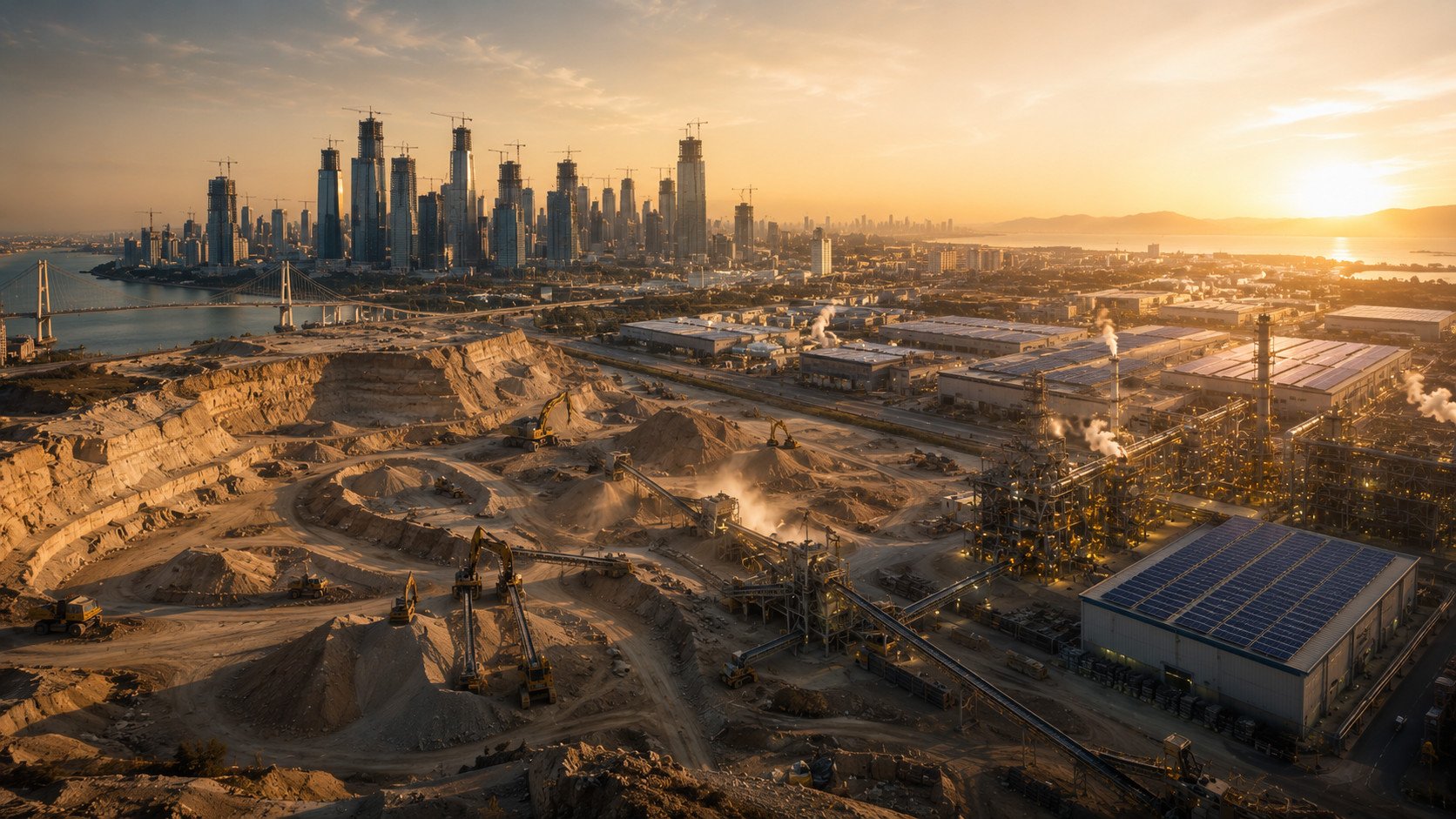
When analyzing the foundational drivers of the global economy, commodities like crude oil, lithium, and rare earth elements typically dominate strategic conversations. Sand is rarely considered. Yet, this ordinary material forms the structural bedrock of modern civilization. From the concrete that anchors skyscrapers and highways to the high-clarity glass on smartphones and the ultra-pure silicon driving advanced semiconductor microchips, sand is one of the most critical resource inputs supporting macroeconomic growth.
As global urbanization and infrastructure expansion accelerate, a critical supply challenge is emerging: the global economy is consuming specific types of sand at a rate far exceeding natural geological replenishment.
The Material Foundation of Global Growth
Sand is among the most heavily volume-extracted raw materials on Earth. According to United Nations Environment Programme (UNEP) assessments, global demand for sand and gravel reaches an unprecedented 50 billion tonnes annually, heavily driven by four baseline economic pillars:
- Infrastructure & Urban Construction: The fundamental aggregate required for concrete, cement mixes, highways, and bridges.
- Industrial Glass Manufacturing: The raw material for architectural glass, automotive components, and smartphone displays.
- Clean Energy Architecture: A vital component in the production of photovoltaic solar panels and fiber-optic telecommunication cables.
- Advanced Electronics: The core mineral source for high-purity silicon used in semiconductor wafer fabrication.
Every expanding metropolis, industrial zone, transit hub, and green energy project depends on massive volumes of aggregate. Modern economic development is quite literally constructed grain by grain.
The Desert Paradox: The Illusion of Abundance
At first glance, the concept of a global sand shortage appears structurally contradictory given that massive deserts cover a third of the Earth's land surface. However, a stark geological distinction exists: desert sand is completely incompatible with construction and industrial needs.
Desert grains are continuously shaped by wind erosion, making them smooth, rounded, and incapable of binding cohesively within cement mixtures. Conversely, construction and industrial manufacturing require angular, jagged grains that lock together securely under pressure. This specific material must be harvested from dynamic aquatic environments—including riverbeds, lakes, and coastlines—or extracted through energy-intensive terrestrial quarrying. This geological reality transforms sand from an apparently limitless commodity into a geographically finite, strategically sensitive resource.
The Intersecting Demands of Technology and Infrastructure
The ongoing pressure on sand resources highlights an unexpected link between heavy urban development and high-tech manufacturing. While the construction sector accounts for the largest aggregate volume consumption, the digital economy relies heavily on industrial silica sand.
High-purity silica sand, valued as a multi-billion dollar strategic market, must undergo rigorous chemical refining to eliminate trace iron and impurities. Once processed into ultra-high-purity quartz and silicon, it acts as the irreplaceable substrate for advanced semiconductor microelectronics, high-speed fiber-optic lines, and solar cells. As global competition intensifies to build out domestic semiconductor fabrication units and hyperscale data centers, securing a resilient supply chain of industrial silicates has evolved into a matter of national technological sovereignty.
The GeoFinance Perspective
Historically, every phase of economic development has been anchored by a definitive material. Coal powered early industrialization; oil enabled the global transportation revolution; and critical minerals now dictate the clean energy transition. Yet, the physical architecture of the global economy still depends entirely on materials that escape public attention.
The core challenge facing modern states is not the absolute depletion of sand on a planetary scale. Rather, it is the capacity of national economies to secure stable, sustainable, and logistically viable access to the specific grades of aggregate and high-purity silica required to build out their future physical and digital infrastructure.