
Part 1) Russia–Ukraine War: The Energy Shock Nobody Predicted
When Russian forces crossed into Ukraine on February 24, 2022, financial analysts and energy economists broadly expected a short-lived military operation with manageable economic consequences. Within weeks, that assumption was shattered. What followed was the largest energy supply disruption to hit Europe since the 1970s — a crisis that rewrote the continent's energy strategy, accelerated the global LNG trade, and demonstrated that a single pipeline system could hold the economic stability of 27 nations in temporary suspension.
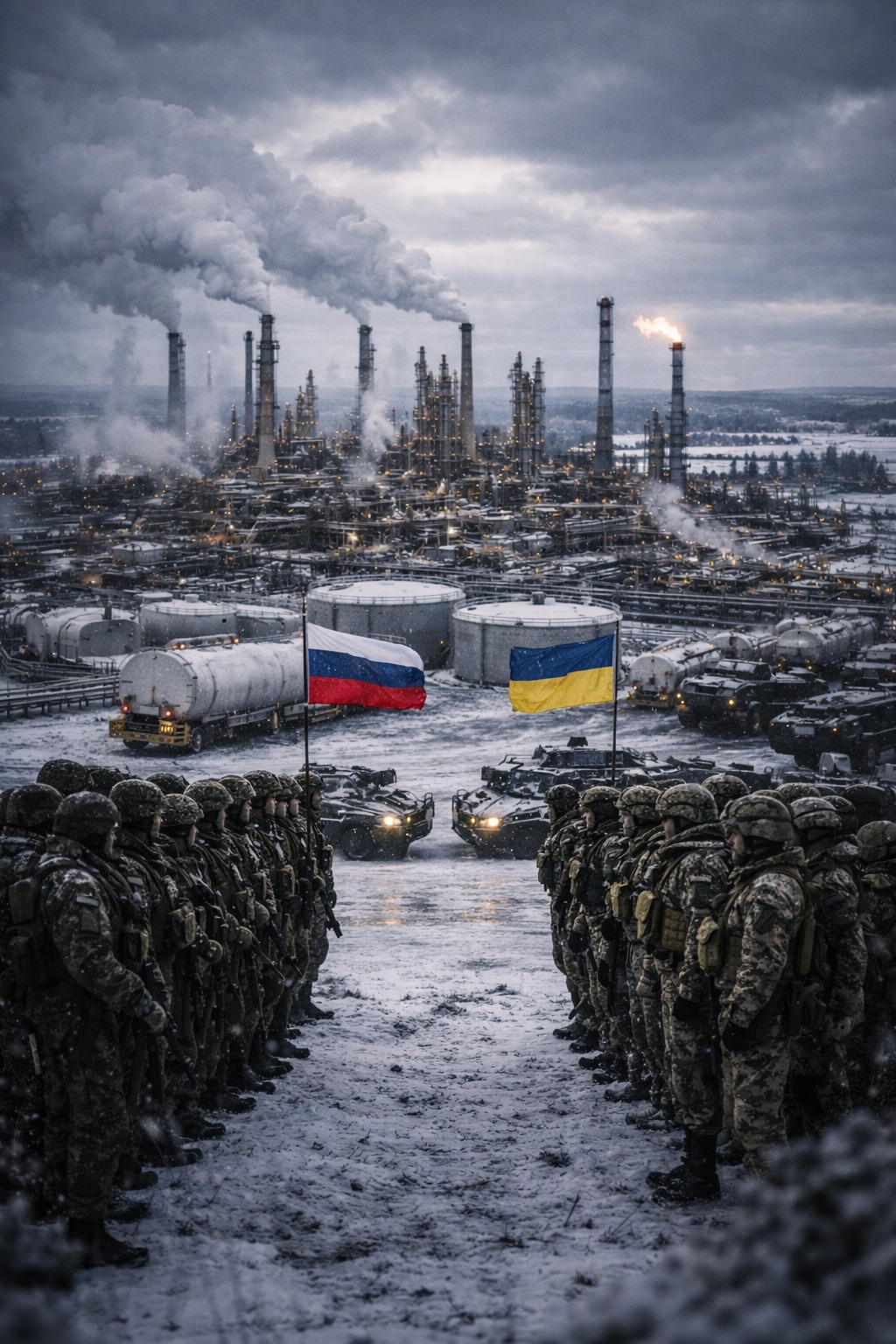
The European Energy Crisis: Shattered Assumptions
When Russian forces crossed into Ukraine on February 24, 2022, financial analysts and energy economists broadly expected a short-lived military operation with manageable economic consequences. Within weeks, that assumption was shattered. What followed was the largest energy supply disruption to hit Europe since the 1970s — a crisis that rewrote the continent's energy strategy, accelerated the global LNG trade, and demonstrated that a single pipeline system could hold the economic stability of 27 nations in temporary suspension.
The Energy Dependency That Made Europe Vulnerable
For decades, Europe had built its industrial economy on a foundation of cheap Russian natural gas. By the eve of the 2022 invasion, Russia supplied approximately 40 percent of the European Union's total natural gas consumption — a dependency that had deepened steadily since the 1970s. In Germany, the figure was closer to 55 percent. In Italy, 40 percent. In several Central and Eastern European states, the dependency exceeded 80 percent.
This was not a strategic oversight but a deliberate economic calculation: Russian gas was cheap, reliable under normal conditions, and delivered through an established pipeline network. The Nord Stream 1 pipeline alone carried up to 55 billion cubic metres of gas per year directly from Russia to Germany under the Baltic Sea. When Russia began using gas flows as a political instrument in mid-2022 — first reducing deliveries, then halting them — Europe had no short-term substitute at the volumes required.
The Energy Weaponisation Strategy
Russia's approach was systematic rather than sudden. In June 2022, Gazprom reduced Nord Stream 1 flows to 40 percent of capacity, citing turbine maintenance. By late July, flows fell to 20 percent. In August, the pipeline was shut entirely for scheduled maintenance. When it reopened, it operated at reduced capacity until September 2022, when flows stopped completely.
In September 2022, Nord Stream 1 and 2 were sabotaged in a series of underwater explosions in the Baltic Sea, rendering both pipelines permanently inoperable. The attack — whose origin remains officially disputed — eliminated the possibility of a rapid diplomatic resolution restoring gas flows through that route. European governments that had hoped for a negotiated return to normal now faced the reality that the pipeline era in European energy had ended.
The Immediate Economic Impact
The consequences moved rapidly from energy markets into the broader economy. European natural gas prices — measured by the Dutch TTF benchmark — rose from approximately €25 per megawatt-hour in early 2022 to a peak of €340 per megawatt-hour in August 2022, a thirteenfold increase in less than eight months. Industrial energy consumers — steel mills, chemical plants, fertiliser producers, glass manufacturers — faced cost structures that made production uneconomical. Several major industrial facilities reduced or suspended output.
The inflationary effect was severe and immediate. Eurozone inflation reached 10.6 percent in October 2022, driven primarily by energy and food prices. The European Central Bank, which had maintained negative interest rates for years, was forced into the most aggressive tightening cycle in its history — raising rates by 450 basis points between July 2022 and September 2023. The inflation and rate shock together compressed consumer spending, corporate investment, and economic output across the continent.
Why Nobody Predicted the Scale
The severity of the economic shock surprised analysts for several reasons. First, the assumption held widely before 2022 was that Russia would not risk the revenue from gas exports — at the time worth roughly $100 billion per year — by weaponising supply. That assumption proved wrong. Second, the speed at which Russia was willing to accept economic damage from Western sanctions in exchange for political leverage was underestimated. Third, Europe's emergency LNG import infrastructure simply did not exist at the scale needed — floating storage and regasification units had to be procured and positioned at speed to provide even partial relief.
Part 2 covers the full financial and market fallout: what happened to European energy stocks, the currency markets, sovereign bond yields, the industrial base, and the long-term restructuring of the continent's energy strategy.